Celebrate Navratri and Dussehra with hands-on crafts, printables, books and cultural activities for kids. These ideas are designed for families, preschool and elementary classrooms, and homeschool lessons.
When my daughter was little, she once asked, “What is Navratri? Navratri means holidays for school, correct mummy?” Questions like that are wonderful conversation starters. Festivals give us a natural way to talk about stories, traditions, regional celebrations, art, music and family customs while children are excited to participate.
This collection brings together some of our favorite Navratri and Dussehra activities for kids, including Dandiya and Garba, rangoli, Durga crafts, Ramayana activities, Ravana crafts, Mysuru Dasara, Golu or Bombe Habba, festive decorations and low-prep printables.
Exploring Indian culture with children? You may also enjoy our India crafts and activities for kids, Around the World Crafts for Kids and Teacher Resources.

Updated September 2026.
- Best for: Preschool, kindergarten and elementary-age children
- Use at: Home, school, homeschool, culture week and Indian festival units
- Subjects: Art, social studies, geography, literature, music and cultural studies
- Activities include: Dandiya, Garba, rangoli, Durga crafts, Ramayana activities, Ravana crafts, Mysuru Dasara, Golu and festival printables
- Main learning goal: Discover how Navratri and Dussehra are celebrated in different ways across India
Good Navratri and Dussehra activities for kids include decorating Dandiya sticks, learning simple Garba steps, making rangoli, creating Durga and Ravana crafts, reading a child-friendly Ramayana story, learning about Mysuru Dasara and Golu or Bombe Habba, making festive paper flowers and using Navratri-themed printables. For school and homeschool lessons, connect each activity to the Indian region or tradition where it is especially important.
In 2026, Shardiya Navratri begins on Sunday, October 11, and Vijayadashami or Dussehra falls on Tuesday, October 20. Festival timings and some observances can vary by region and local calendar, so families may wish to check their local panchang for specific timings. The dates can also be checked on the Government of India’s Dussehra festival guide.
Navratri means “nine nights” and is a major Hindu festival dedicated to the divine feminine, or Shakti. The ways in which Navratri is observed vary greatly across India.
Dussehra, also called Vijayadashami, is celebrated at the end of the Navratri period. In many parts of North India it is associated with Lord Rama’s victory over Ravana in the Ramayana. In other traditions, Vijayadashami celebrates Goddess Durga’s victory over Mahishasura. Across these stories, the festival is widely associated with the triumph of good over evil.
A note for parents and teachers: Navratri and Dussehra are living religious and cultural traditions, and customs vary between regions and families. Present these activities as examples rather than suggesting that every Hindu family celebrates in exactly the same way.
One of the most interesting things for children to learn is that Navratri is not celebrated in exactly the same way everywhere.
- Gujarat: Garba and Dandiya Raas are among the best-known Navratri traditions.
- West Bengal and eastern India: Durga Puja is a major celebration centered on Goddess Durga.
- Karnataka: Mysuru Dasara is famous for its grand procession, while many families also celebrate Bombe Habba.
- Tamil Nadu and parts of South India: Families may arrange Navratri Golu or Kolu displays with dolls on tiered steps.
- Telangana: Bathukamma is celebrated with beautiful arrangements of seasonal flowers.
- North India: Ramlila or Ram Leela performances and Ravana Dahan are closely associated with Dussehra.
- Himachal Pradesh: Kullu Dussehra begins on Vijayadashami and continues with processions and regional traditions.
- Kerala and parts of South India: Saraswati Puja and Vidyarambham connect Vijayadashami with books, music and the beginning of learning.
This makes Navratri and Dussehra a wonderful topic for a classroom map activity. Ask children to find Gujarat, West Bengal, Karnataka, Tamil Nadu, Telangana, Himachal Pradesh and Kerala on a map and match each place with one tradition.
Choose an Activity
- Dandiya & Garba
- Rangoli & Festive Decorations
- Mysuru Dasara
- Durga Puja & Navadurga Crafts
- Ramayana & Ravana Activities
- Golu, Kolu & Bombe Habba
- Classroom Lesson Ideas
- Books for Kids
Best for: Ages 5+ | Time: 25–35 minutes | Prep: Low
In Gujarat, people gather during Navratri for energetic Garba and Dandiya Raas celebrations. Dandiya uses decorated wooden sticks, making a simple pair of craft sticks or child-safe dowels a fun festival art project.
You’ll need: Two thick craft sticks or child-safe wooden dowels, ribbon or colored tape, glue and small paper or foam decorations.
- Wrap each stick with colorful ribbon or tape, leaving the ends easy to hold.
- Add narrow bands of contrasting color, paper shapes or tiny mirror-style stickers.
- Press down loose edges firmly and let all glue dry before dancing.
Use paper tubes or foam-covered sticks with younger children, and leave plenty of space between dancers. See our original decorated Dandiya stick tutorial.

Learn Simple Dandiya and Garba Steps
Best for: Ages 5+ | Time: 10–15 minutes | Prep: Clear an open space
Once the sticks are ready, turn the craft into a movement activity. Start without sticks and ask children to listen for the beat.
- Step to the right, bring the feet together and clap.
- Repeat to the left, keeping the movements slow and even.
- When everyone is comfortable, move in a large circle and gently tap Dandiya sticks with a partner on the beat.
For a classroom, this works especially well as a short music-and-movement activity after learning about Gujarat. Keep the pattern simple and focus on rhythm, coordination and enjoying the group activity.

Best for: Ages 4+ | Time: 20–40 minutes | Prep: Low to moderate
Many families decorate their homes during the festive season, and rangoli is one of the most colorful ways children can take part. Young children can work with simple geometric patterns, flower shapes, dots and bright colors.
For a low-mess classroom version, draw a large symmetrical outline on paper and let children fill it with crayons, paper pieces or dot stickers. Older children can use colored rice, flower petals or rangoli powder on a tray. Floral and geometric designs are especially easy to use in multicultural classrooms.
Try our quick rangoli activity for kids →

For another variation, explore these easy rangoli designs for kids.

Make Festive Paper Marigold Flowers
Best for: Ages 6+ | Time: 30 minutes | Prep: Cut tissue rectangles for younger children
Marigolds are widely used in Indian festive decorations. Paper versions are easy to make, last longer than fresh flowers and can be turned into garlands, table decorations or classroom displays.
You’ll need: Orange and yellow tissue paper, scissors, green pipe cleaners or thread.
- Stack four to six small tissue-paper rectangles.
- Accordion-fold the stack and secure the center with a pipe cleaner or thread.
- Round the two ends with scissors.
- Gently separate each tissue layer and fluff it into a marigold shape.
Make several flowers and thread them together for a paper garland. Younger children may need help separating the delicate layers.

Make a Simple Shubh Dussehra Card
Best for: Ages 4+ | Time: 20–30 minutes | Prep: Low
Festival cards are an easy activity for younger children. Fold a sheet of cardstock in half and decorate the front with paper marigolds, a bow and arrow, a rangoli motif or a bright Mysuru elephant. Add “Shubh Dussehra” to the front and invite children to write a kind festival message inside for grandparents, cousins or friends.
Learn About the Mysuru Dasara Festival
Best for: Ages 5–10 | Time: 30–45 minutes | Prep: Help younger children cut the elephant shape
Mysuru Dasara, also commonly searched as Mysore Dasara, is one of Karnataka’s best-known celebrations. The Vijayadashami procession is famous for its ceremonial displays and decorated elephants. This makes it a wonderful opportunity to connect a craft with Indian geography, Karnataka and local festival traditions.
Make our Mysuru Dasara elephant paper craft →

You can also browse our older collection of Dasara elephant crafts.
Durga Puja is especially important in West Bengal and other parts of eastern India. Goddess Durga is widely associated with strength, courage and the victory over Mahishasura. Durga Puja in Kolkata was added to UNESCO’s Representative List of the Intangible Cultural Heritage of Humanity in 2021.
Explore our dedicated collection of 15 Durga Puja crafts for kids for paper, clay and recycled-material projects.
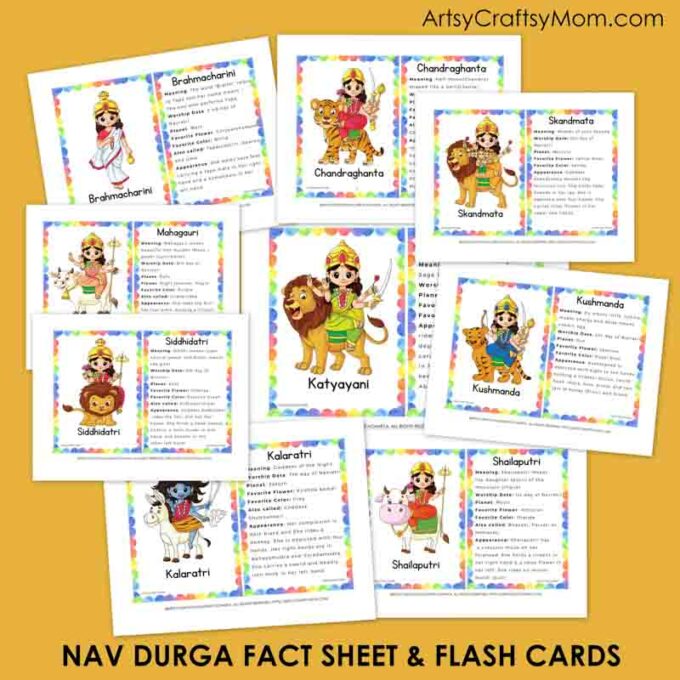
The nine forms of Goddess Durga worshipped during Navratri are collectively known as Navadurga: Shailaputri, Brahmacharini, Chandraghanta, Kushmanda, Skandamata, Katyayani, Kalaratri, Mahagauri and Siddhidatri.
Our Printable Nav Durga Flashcards are an easy way to introduce the nine forms. Print them on cardstock and laminate them if you plan to reuse them in a classroom or homeschool setting.
Make a Durga Craft
Best for: Ages 7+ | Time: 40–50 minutes | Adult help: Preparing the recycled CD
Try this upcycled Durga-themed craft or explore the larger Durga Puja roundup linked above. Encourage children to observe patterns, jewelry, symmetry and the way different artists represent Goddess Durga respectfully.
Make our Durga-themed upcycled CD craft →

Ramayana and Dussehra Crafts for Kids
Dussehra is a good time to introduce a child-friendly version of the Ramayana. The epic tells the story of Rama, Sita, Lakshmana, Hanuman and Ravana and has been retold through books, theatre, dance, puppetry and regional performance traditions for generations.
For a larger collection, explore our Dussehra and Ramayana crafts for kids.
Ramayana Color by Number Printable
Best for: Ages 5–10 | Time: 20–35 minutes | Prep: Print and go
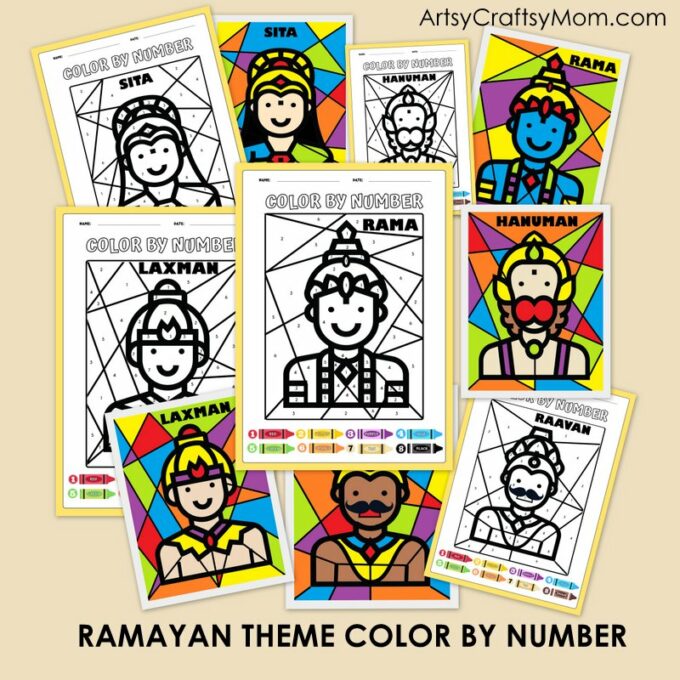
Need a low-prep classroom activity? These Ramayan Printable Color By Number Sheets work well for festival centers, quiet time, homeschool culture lessons and classroom displays.
Make a Paper Roll Ravana
Best for: Ages 6+ | Time: 40–50 minutes | Prep: Save a clean cardboard tube
A ten-headed Ravana craft is a fun way to begin a conversation about the Dussehra story. Use the finished craft for storytelling or a small Ramlila puppet activity.
Make the paper roll Ravana craft →

Put on a Ramayana Puppet Show
Invite children to retell a short, age-appropriate part of the story with paper puppets.
- Choose a few characters such as Rama, Sita, Lakshmana, Hanuman and Ravana.
- Divide the story into three or four short scenes.
- Let one child narrate while others move the puppets and speak simple lines.
- Finish by putting the scenes in order and discussing the choices made by the characters.
This combines literature, speaking, sequencing and art in one project. Find character inspiration in our Ramayana craft collection.

In parts of South India, Navratri is celebrated with tiered doll displays known as Golu, Kolu or Bombe Habba. Families arrange dolls and miniature scenes on steps, often including deities, mythological stories, people, animals, village scenes and everyday life.
The exact customs vary by family and region, and modern displays can be traditional, themed or highly creative. Visiting friends and relatives to see their Golu displays is also an important social part of the season for many families.
See our guide to keeping a Golu at home →

What Can Children Notice in a Golu Display?
- How many steps are used?
- Which characters or stories can they identify?
- Can they spot musicians, animals, vendors or village scenes?
- Which dolls appear handmade?
- Can they create a tiny themed scene of their own?
For school use, children can create a small collaborative “class Golu” using paper figures or recycled materials rather than recreating a family worship display. Our paper cup miniature village is a lovely way to add houses and scenery.
Teachers do not need an elaborate setup to turn this festival into a meaningful culture lesson. Choose one or two activities and connect them to geography, storytelling, art or music.
- Map India: Locate different states and match each one with a Navratri or Dussehra tradition.
- Make Dandiya sticks: Decorate paper or craft-stick versions and learn a few simple rhythmic movements.
- Create a collaborative rangoli: Give each child one section of a large symmetrical design.
- Tell a Ramayana story: Use puppets, sequencing cards or a read-aloud.
- Compare regional celebrations: Garba, Durga Puja, Mysuru Dasara, Golu, Bathukamma and Ramlila make an excellent comparison chart.
- Use low-prep printables: Nav Durga cards or Ramayana color-by-number sheets are useful for centers and early finishers.
- Add music and movement: Listen to Garba or Dandiya rhythms and identify the beat.
A Simple 45-Minute Classroom Plan
- 5 minutes: Locate four Indian states on a map.
- 8 minutes: Introduce how celebrations differ by region.
- 7 minutes: Read a short festival or Ramayana story.
- 20 minutes: Complete one craft or printable.
- 5 minutes: Let children share one new thing they learned.
Looking for more lesson-friendly ideas? Browse our Teacher Resources and Around the World Crafts for Kids.
Navratri and Dussehra activities can help children understand that a single festival season can have many regional traditions. Through crafts, stories, maps, music and books, children can explore Indian geography, Hindu mythology, visual art, performance, family traditions and the ways festivals change from one part of India to another.
Books are one of the easiest ways to add context before or after a craft. For younger children, choose picture books with clear illustrations and simple explanations; older elementary children can compare different retellings of the same festival or epic story.
Disclosure: This section contains Amazon affiliate links. As an Amazon Associate, Artsy Craftsy Mom earns from qualifying purchases at no extra cost to you.
Celebrate Durga Puja With Me! — Shoumi Sen

A rhyming picture book that introduces young children to the excitement and traditions of Durga Puja. Best for: Picture-book read-alouds and early elementary culture lessons.
Celebrate!: Dussehra & Durga Puja

A useful festival book for children who want to learn why Dussehra and Durga Puja are celebrated. Best for: Elementary festival units and family reading.
Ved and Friends Celebrate Dussehra and Diwali — Diksha Pal Narayan

This book brings together stories about Navratri, Golu, Durga Puja, Ram, Sita, Ravana and other festival traditions. Best for: Elementary children and families learning about Indian festivals away from India.
Amma, Tell Me About Durga Puja! — Bhakti Mathur

The Amma, Tell Me About series introduces Indian mythology and festivals through child-friendly storytelling. Best for: Family read-alouds and children who enjoy story-led explanations.
Amma, Tell Me About Ramayana! — Bhakti Mathur
A short, accessible retelling that works well before a Ramayana craft or puppet-show activity. Best for: Introducing the main characters and story sequence.
Food is another wonderful way to explore a festival with children. In many South Indian homes, different varieties of sundal made with legumes are prepared during Navratri. If you include a food activity in school, always check allergy policies and obtain any required family permissions first.
For traditional recipe inspiration, visit Subbus Kitchen’s Navratri and sundal recipes.

Navratri is a Hindu festival celebrated over nine nights. Different parts of India celebrate it in different ways, including Garba and Dandiya dancing, Durga Puja, Golu displays, music, prayers, decorations and family gatherings.
Why is Dussehra celebrated?
Dussehra, or Vijayadashami, is associated with the victory of good over evil. In the Ramayana tradition it celebrates Lord Rama’s victory over Ravana. In Durga traditions it is connected with Goddess Durga’s victory over Mahishasura.
Easy Navratri activities include decorating Dandiya sticks, making a simple paper rangoli, creating paper marigold flowers, coloring Nav Durga or Ramayana printables, learning Garba steps and reading a festival picture book.
What are some good Dussehra activities for school?
For school, try a map of regional celebrations, a Ramayana puppet show, a paper Ravana craft, a Mysuru Dasara elephant project, collaborative rangoli art or a comparison chart showing how the festival is celebrated in different parts of India.
Navratri is a nine-night festival period with many regional traditions. Durga Puja is a major celebration of Goddess Durga, especially associated with West Bengal and eastern India. Dussehra or Vijayadashami comes at the end of the festival period and is connected with different victory traditions, including Rama’s victory over Ravana and Durga’s victory over Mahishasura.
Shardiya Navratri begins on October 11, 2026, and Vijayadashami or Dussehra falls on October 20, 2026. Local timings and observances can vary.
More Indian Festival Crafts and Activities
- India Crafts and Cultural Activities
- 15 Durga Puja Crafts for Kids
- Ramayana and Dussehra Crafts
- 100+ Diwali Crafts and Activities
- Around the World Crafts for Kids